Blog ·
Is low-stimulation content really better for toddlers? What the research says
Slower songs, softer sounds and fewer scene changes. Here's what science says about calm content for little ones, and what it doesn't say yet.
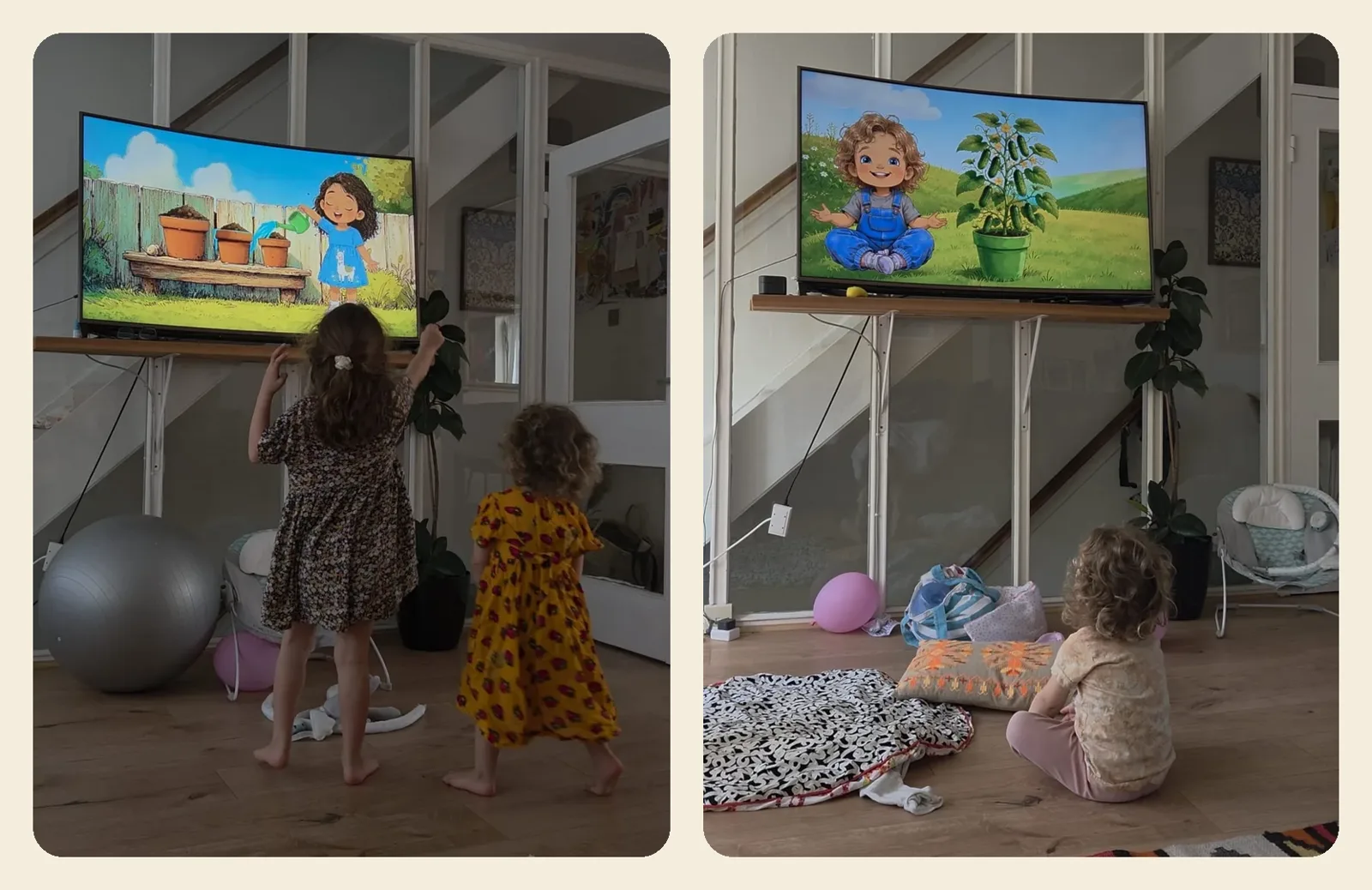
Ask a room of parents about children's TV and someone will mention "low-stimulation" or "slow TV" within a minute. It has become one of the biggest parenting conversations online. But is calm content actually better for little ones, or is it just nostalgia? We dug into the research so you don't have to.
What does "low-stimulation" actually mean?
There is no official scientific definition. It is a parents' term for songs and shows that leave a young child room to keep up: slower pacing, fewer scene changes, softer colours and sounds, simple repeated words and one familiar setting.
In February 2025, Good Morning America described a growing "Slow TV" movement, with parents swapping fast, noisy programmes for calmer shows, often the ones they grew up with themselves. Some parenting creators now advise skipping programmes with lots of sound effects, rapid scene changes or a hyperactive tone.
What the research says
Fast pace can tire young minds, at least for a while
The study most often quoted comes from the University of Virginia. Psychologists randomly split sixty 4-year-olds into three groups for nine minutes: one watched a fast-paced cartoon, one watched a slower, realistic educational cartoon, and one drew pictures.
Straight afterwards, the children took four tasks measuring executive function, the skills behind paying attention, waiting patiently and remembering instructions. The fast-paced group did significantly worse than the other two groups, even after taking into account the children's age, attention and usual TV habits. The slower cartoon and the drawing groups performed about the same.
It is an important study, but a small one. It measured effects immediately after watching, not long-term harm, and the cartoon used was made for older children. The authors' conclusion was careful: fast-paced shows could at least temporarily affect young children's executive function.
Gentle songs relax babies' bodies
A 2020 study from Harvard's Music Lab looked at music rather than TV. Researchers played 144 babies short songs from cultures they had never heard: some lullabies, some dance and other songs. The babies' heart rates dropped when the singing started, and dropped more for lullabies. Their pupils and skin responses also showed they were relaxing.
The babies didn't know the languages or melodies, yet the lullabies still calmed them. That suggests something in the music itself, such as slow tempos and smooth melodies, does the work. We explore this more in Why lullabies work.
Less screen time, and more of it together
In 2019 the World Health Organization published its first guidance for under-fives. It recommends no screen time for babies under one, and no more than an hour a day for children aged two to four, with less being better. The American Academy of Pediatrics advises avoiding screens (other than video calls) before 18 months, and choosing high-quality programmes that parents watch together with young children.
Not every expert agreed with strict limits. The UK's Royal College of Paediatrics and Child Health said the evidence was too weak to set firm thresholds, and an Oxford researcher argued that what children watch, and how, matters as much as how long.
What we don't know yet
Here is the honest bit. As Dr Amy Webb of The Thoughtful Parent pointed out in December 2025, there is not yet much direct research on "low-stimulation" content as a category. "Slow TV" is a parenting trend, not a scientific term. The case for it rests on neighbouring evidence: studies of fast pacing, of how babies respond to music, and of how screens change family interaction.
That evidence points in a consistent direction, but calm content is not magic. The biggest thing in your child's day is still you: your voice, your attention and the time you spend together.
How we use this at My Garden Songs

These ideas shape every song we make. Every song happens in one garden with the same four friends, so there is no visual whiplash. Tempos are relaxed, voices are warm and never shouted, and words repeat enough times for a toddler to own them. Songs like Poppy Peep are written for winding down, while Diggy Dots is a clap-along chant that still keeps a steady, predictable beat.
You can read more about how we design each song in why we make calm music, or browse all our low-stimulation songs for toddlers.
Simple ideas for calmer screen time
- Watch and sing together. Joining in turns screen time into conversation time.
- Choose a steady tempo and lots of repetition. If your toddler can predict the next line, the song is working.
- Switch off background TV. A screen left on in the background competes for attention even when nobody is watching.
- Take the song off the screen. Sing it again in the bath, in the car or while you garden together.
- End the day with a slow song. Keep the fast, bouncy favourites for the morning.
References
- Lillard, A. S. & Peterson, J. (2011). The immediate impact of different types of television on young children's executive function. Pediatrics, 128(4), 644–649. doi.org/10.1542/peds.2010-1919
- University of Virginia (2011). Fast-paced, fantastical television shows may compromise learning, behavior of young children. ScienceDaily
- Bainbridge, C. M., Bertolo, M., et al. (2021). Infants relax in response to unfamiliar foreign lullabies. Nature Human Behaviour, 5, 256–264. doi.org/10.1038/s41562-020-00963-z
- World Health Organization (2019). Guidelines on physical activity, sedentary behaviour and sleep for children under 5 years of age. who.int
- Associated Press (2019). No screen time for babies; only 1 hour for kids under 5 (includes responses from the RCPCH and Oxford Internet Institute). KTVU
- American Academy of Pediatrics, Council on Communications and Media (2016). Media and young minds. Pediatrics, 138(5), e20162591. doi.org/10.1542/peds.2016-2591
- Good Morning America (11 February 2025). The "Slow TV" movement: Why parents are turning back the clock on kids' programming. goodmorningamerica.com
- Webb, A. (10 December 2025). Are low-stimulation shows really better for children? The Thoughtful Parent. thoughtfulparent.com
New calm songs every monthSubscribe